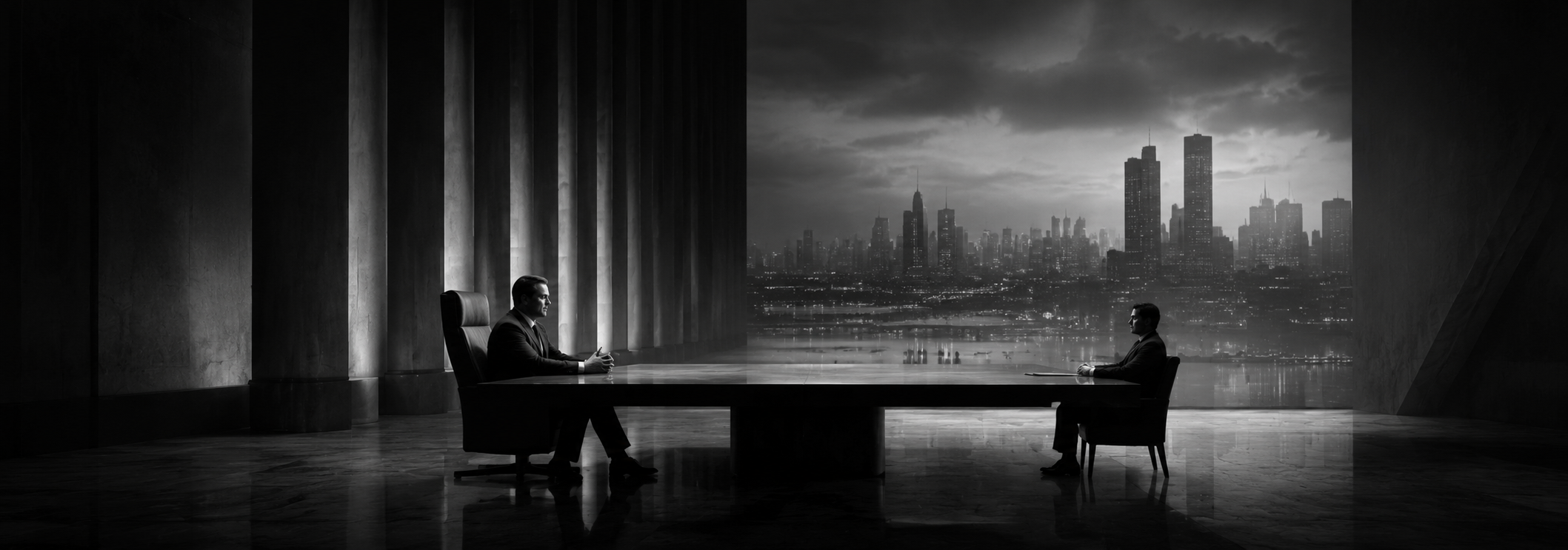
The Architecture of Coercion Beneath the Language of Mediation
From Negotiation Theory to Machiavellian Field Analysis: The Architecture of Coercion Beneath the Language of Mediation
How the language of win-win can conceal an old architecture of power
Sometimes the best illustration of Machiavelli does not come from books. It comes from the market of professional services.
When a company capable of creating advantage through pressure, asymmetry, legal exhaustion, reputational leverage or other non-sterile methods begins to offer “mediation”, the result is almost comic. But inside this comedy there is an important diagnosis of the modern field.
A force-based actor no longer needs to speak the language of direct threat. It can speak the language of win-win, facilitation, constructive dialogue and peaceful settlement.
The problem is simple: the language may change while the nature of action remains the same.
In psychology, Machiavellianism is usually treated as part of the so-called Dark Triad, alongside narcissism and psychopathy. In that sense, the term is commonly associated with manipulative communication, hidden control, cold instrumental use of people and the attempt to manage situations through indirect leverage.
But here we will look at Niccolò Machiavelli not as a symbol of manipulation, but as an architect of the game.
Not as someone who teaches deception, but as a thinker who allows us to look at the field without its decorative layer: without moral theatre, without naive faith in the rationality of all parties, and without the assumption that correct language can, by itself, change the actual behaviour of players.
His basic logic is simple: remove the emotional layer, look at the situation as a structure, and derive the equation that makes the desired result possible.
Modern negotiation culture is often built around the humanisation of process. The Harvard school, integrative negotiation techniques, win-win logic, the search for a zone of possible agreement, and the attempt to find solutions acceptable to all parties.
This is an important and powerful school of thought. But it has one critical condition: the parties must recognise the value of the shared field itself.
When the parties genuinely want to reach an agreement, this logic works. When they recognise a basic symmetry of process, respect each other’s boundaries and see agreement as better than conflict, the language of win-win can create real value.
The Limits of the Win-Win Framework
But there are situations where this symmetry does not exist.
The interests of the parties may not merely diverge. They may be structurally incompatible. Goals, values, acceptable instruments, time horizons and the very nature of the desired outcome may differ so deeply that a “shared solution” is not the starting point, but a distant consequence of first changing the field.
In such situations, the problem is not that the parties communicate poorly.
The problem is that the field has already been constructed as a conflict of incompatible trajectories.
There is another error that even professional negotiators often underestimate: the excessive rationalisation of the situation.
This is especially visible in crisis negotiations. Especially where what matters is not only what a party says, but what it hides. What it risks losing. What it fears. What dependency it cannot acknowledge. What internal conflict it masks behind a rational position.
We often overestimate human rationality.
We assume that a party can evaluate options, compare consequences and move toward an optimal structure. But in the real field, behavioural patterns, fear of status loss, resentment, shame, hidden aggression, fatigue, inertia or the absence of shared semantics can destroy even a well-prepared negotiation process.
These limitations reveal a deeper issue. Once the assumptions of symmetry, transparency and rational cooperation begin to fail, negotiation theory alone is no longer sufficient. The analysis must shift from communication to structure, from declared intentions to underlying incentives.
Enter Machiavelli: From Dialogue to Structure
This is where Machiavelli enters.
He does not ask: “How can we all reach the right agreement?”
He asks a different question: “How is this field actually structured?”
Who has power, and who merely imitates power?
Who controls the resource, and who controls the risk?
Who depends on time?
Who fears a formal decision?
Who has the right, but no access?
Who has access, but no legitimacy?
Who cannot exit the conflict without losing face?
In this sense, Machiavelli is not simply a theorist of power. He is an architect of asymmetry.
His thinking begins where the belief ends that an argument, by itself, can change the behaviour of the other side. He understands that people often act not through truth, but through fear, interest, ambition, dependency, reputation, shame or the desire to preserve control.
For him, the essential issue is not declaration, but configuration.
Not “what should be said”, but “what structure must be created”.
Not “how to persuade”, but “how to make the necessary move the least risky or most advantageous move for the other side”.
This is the architecture of the game.
The Civilised Language of Modern Coercion
Today, this logic has become even more important because modern conflict less and less often appears as direct pressure. It has learned to speak the language of civilisation.
A force-based actor does not necessarily arrive with an open threat. It may arrive with the language of win-win, facilitation, mediation and constructive settlement. Yet behind this language, the old logic may remain: first create an imbalance, then offer a “peaceful solution” on the terms of the party that created the imbalance.
This is why the name of an instrument guarantees nothing.
Mediation, in its proper meaning, implies voluntariness, balance between parties, neutrality of process, transparency of interests and a genuine search for an acceptable solution. But if one actor retains hidden instruments of coercion, controls the tempo of exhaustion or can continue to harm the other party outside the negotiation table, mediation ceases to be mediation.
It becomes a negotiation shell for coercion.
This is the new cynicism: structures accustomed to working through fear, asymmetry, legal exhaustion or reputational pressure can present themselves as operators of peaceful settlement. They adopt the language of a civilised field without changing the nature of their own action.
The form becomes soft.
The logic remains force-based.
Machiavelli as a Diagnostic Tool
And this is precisely where Machiavelli is useful not as a justification of cynicism, but as protection against it.
He would say: do not look at the name of the instrument — look at who holds it.
Do not look at the word “mediation” — look at the balance of power.
Do not look at the declaration of dialogue — look at what happens if you refuse.
Do not look at the rhetoric of win-win — look at who benefits from delay, who controls the risk, and who can afford not to agree.
Because mediation without a balance of power is not mediation. It is a soft form of managing the weaker side.
Machiavellian logic, in its stronger sense, is not about manipulation. It is about sobriety.
If the field is not structured, it must be structured.
If a party does not hear arguments, its calculation must be changed.
If a right is not enforced, the cost of non-enforcement must be created.
If an opponent hides in the fog, the conflict must be brought into form.
If everyone speaks about values but acts through interest, one must work with interest.
If a party does not fear agreement but fears the loss of control, it must be shown that control without agreement becomes more expensive.
Strategic Design Rather Than Manipulation
At this point, Machiavelli becomes not dark psychology, but an instrument of strategic design.
He does not reject ethics. He simply does not allow ethics to become blindness.
Because an ethical position without an understanding of the field can become powerless.
And rational argument without leverage can remain merely a beautiful text.
The architect of the game does not necessarily manipulate. He creates a structure in which the actions of parties begin to have cost, consequence and direction.
He sees not only people, but their dependencies.
Not only declared positions, but hidden stakes.
Not only words, but what those words conceal.
Not only conflict, but the mechanics of conflict.
This is why Machiavelli remains important for modern systemic decisions. In business, law, politics, investment, crisis negotiations or the management of complex assets, we rarely deal with ideal models. We deal with fields where power, law, fear, reputation, time and resources are interwoven.
And the task is not always to reach an agreement.
Sometimes the task is first to change the architecture of the field so that agreement becomes possible.
Where win-win is impossible at the start, a new configuration of incentives must first be created.
Where one side benefits from uncertainty, certainty must be introduced.
Where chaos functions as an instrument of control, form must be created.
Where a right exists but is not enforced, a mechanism of compulsion toward reality must be built.
Conclusion: Seeing the Field as It Is
This is the Machiavellian level of thinking in its strong, non-caricatured sense.
Not manipulation of a person.
But architecture of a situation.
Not dark psychology.
But the cold ability to see the field as it is.
Not cynicism.
But the refusal to confuse the desired model of behaviour with the real one.
Because sometimes a result is not born from persuasion.
Sometimes it is born from a properly constructed equation of power, time, risk and interest.