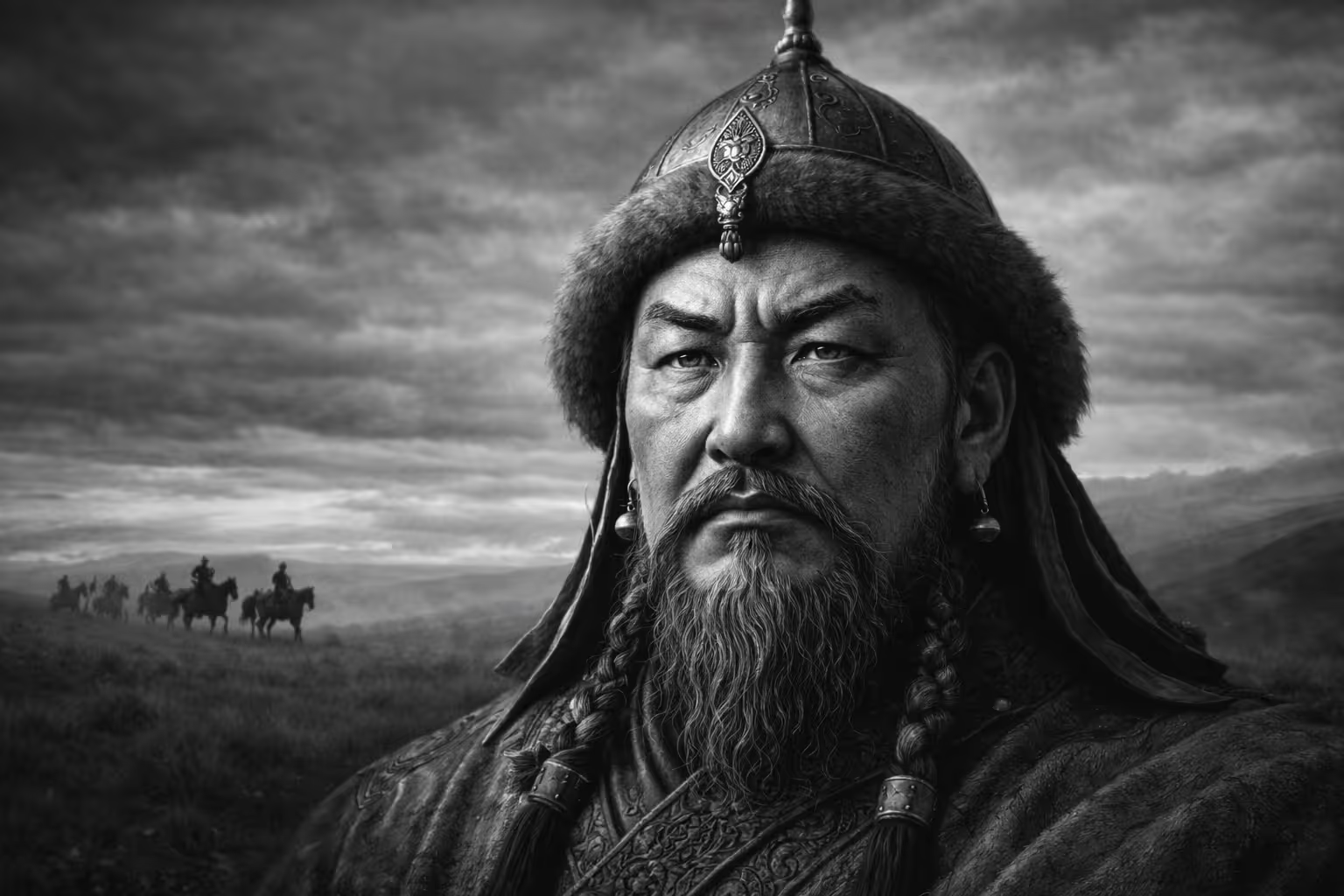
Genghis Khan: Order Born from Emptiness
History and Simplification
History likes simplification. It prefers bright labels: “conqueror,” “barbarian,” “cruelty.” This is exactly what happened to Genghis Khan.
But behind the noise of conquest, a far more interesting question is lost: how is lasting order even possible in a world of total chaos?
The steppe was not a civilization. It had no cities, no institutions, no written laws, no stable memory. There was nothing we would normally call a “state.”
It was a space of movement, scarcity, and short decision horizons.
And yet it was precisely in this environment that one of the most durable imperial structures in history emerged.
Emptiness as a Beginning
Genghis Khan did not rise from the top. On the contrary, he found himself outside any system early on.
Formally, he possessed clan status. Practically, he was stripped of it.
After his father’s death, he and his family were pushed to the margins of steppe life.
For many years, there was no power and no construction — only survival.
This matters not as a biographical detail, but as experience.
He lived through the fragility of status, the conditional nature of tradition, and the emptiness of legitimacy without force.
This is where not an empire begins, but a shift in how reality is perceived.
The Steppe and the Impossibility of Coercion
In the steppe, it is impossible to hold people through fear alone.
They are too mobile. Too autonomous.
Too accustomed to leaving once a framework stops working.
Any order that emerges there cannot be imposed — it must be chosen.
This may be the least obvious aspect of Mongol expansion: its foundation was not total brutality, but predictability.
Rules Instead of Lineage
Where lineage once decided, actions began to matter.
Where alliances were temporary, continuity appeared.
Where chaos reigned, a sense of tomorrow emerged.
This did not look like philosophy. It looked like functioning rules.
For the first time, a person in the steppe gained something simple yet rare: an understanding of the conditions under which tomorrow would not be worse than today.
Empire Not as Territory, but as Method
Perhaps the greatest mistake is imagining the Mongol Empire as a collection of conquered lands.
In reality, it was a network composed of different worlds that did not erase one another.
China did not become the steppe.
The steppe did not become China.
Yet at a certain point, they were able to coexist within a shared logic.
This is why the emergence of the Yuan Dynasty appears not as an anomaly, but as a consequence: the method of organizing life proved flexible enough to integrate into another civilization.
Why It Did Not Collapse Immediately
Many empires die with their founder. The Mongol one did not.
It changed, fragmented, transformed — but it did not disappear overnight.
Perhaps because its foundation was not a figure, but a way of ordering the world.
Where this method was reproduced, the system endured. Where it dissolved, the structure weakened.
Instead of a Conclusion
The story of Genghis Khan is compelling not because he conquered.
But because he demonstrated this: order can emerge not from abundance, but from the absence of foundations.
Not through coercion.
Not through ideology.
But through rules that suddenly prove more beneficial than chaos.
Perhaps this is why the story still carries meaning.
It does not teach. It simply leaves the sense that sometimes order begins with a person who knows too well what its absence feels like.