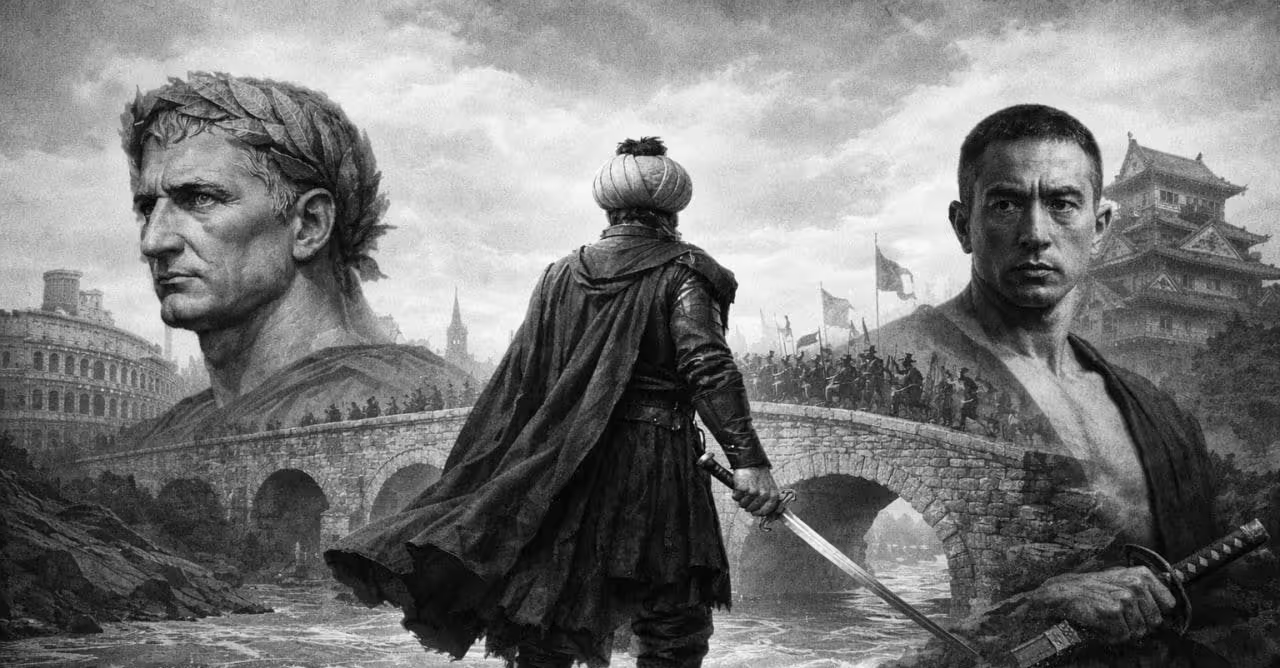
Three Architects and the Rubicon
Behavioral architecture of irreversible decisions
Julius Caesar, Mehmed II the Great, and Yukio Mishima act as system Architects within thesame behavioral model,
where the price of breaking one’s own architecture is the destruction of the agent.
This is not metaphor and not dramatization.
It is a structural law for figures operating at this scale.
The Architect’s Base Model
Architect → Rubicon → elimination of alternatives → total commitment of will and innerpower
After crossing the Rubicon:
- there is no rollback;
- there is no partial solution;
- there is no simulated choice.
The system no longer tolerates:
- an agent without architecture,
- or architecture without an agent.
A collapse between the two results in destruction — political, physical, or symbolic.
Caesar
Architecture Placed Outside the Individual
For Caesar, crossing the Rubicon meant one thing:
defeat equaled the end of political agency and, with high probability, death.
The decisive architectural move was precise:
- the form is placed outside the individual;
- a political system is created that can function after him;
- the destruction of the agent is acceptable, the destruction of the architecture is not.
Caesar could be killed.
The architecture could not.
This is the model of a system founder, not an end-state figure.
Mehmed II the Great
Architecture as Inheritance and Existential Stake
Before the capture of Constantinople, Mehmed faced not a political risk but an existentialverdict.
Defeat meant:
- inevitable physical death;
- immediate revolt;
- total collapse of legitimacy.
But the real exposure was broader.
Mehmed put at stake:
- not only his own life,
- but the entire architecture inherited from his father — the state, the army, and theimperial logic of expansion.
Defeat equaled:
- the death of the agent,
- the discrediting of the dynastic line,
- the destruction of the inherited system.
There was no third option.
Crucially:
- the architecture is not closed on the agent;
- the inheritance is translated into a higher scale;
- Mehmed becomes merely the first administrator of a new imperial form.
This is the ethic of the inheriting Architect:
if I cannot carry and expand what was entrusted to me, I have no right to exist as its agent.
Yukio Mishima
Architecture Closed on the Body
Formally, Mishima operates within the same behavioral model.
The divergence lies in the point of closure.
He recognizes:
- institutions will not accept the form;
- historical time is closed;
- compromise kills the idea
The decision is cold, conscious, and fully reflexive:
to become an enduring architectural symbol.
Seppuku here is neither escape nor defeat.
It is the final verification of form through the agent’s body, carried out with full awareness thatthe outcome is not a system, but a symbol.
The result is precise:
- architecture does not exit into the world;
- the system produces no successors;
- the form ceases to be a process and stabilizes as an eternal symbol.
Mishima secures symbolic permanence at the expense of systemic continuity.
A monumental figure —
yet a solitary one, not a founder.
The Core Distinction
All three operate within the same behavioral architecture.
But the point of closure differs:
- Caesar closes form within a political system.
- Mehmed II the Great closes form within inheritance and imperial scale.
- Mishima closes form upon himself, as an enduring architectural symbol.
This is the boundary between:
- architecture that requires a future,
and
- architecture that consciously abandons the future in favor of symbolic permanence.
Final Conclusion
This is not a text about heroes.
Nor is it a text about death.
It is a model of the Architect’s ultimate responsibility.
An Architect may perish.
But when architecture is closed upon the agent,
it ends with him,
becoming an enduring architectural symbol rather than a living system.
The question is always the same: