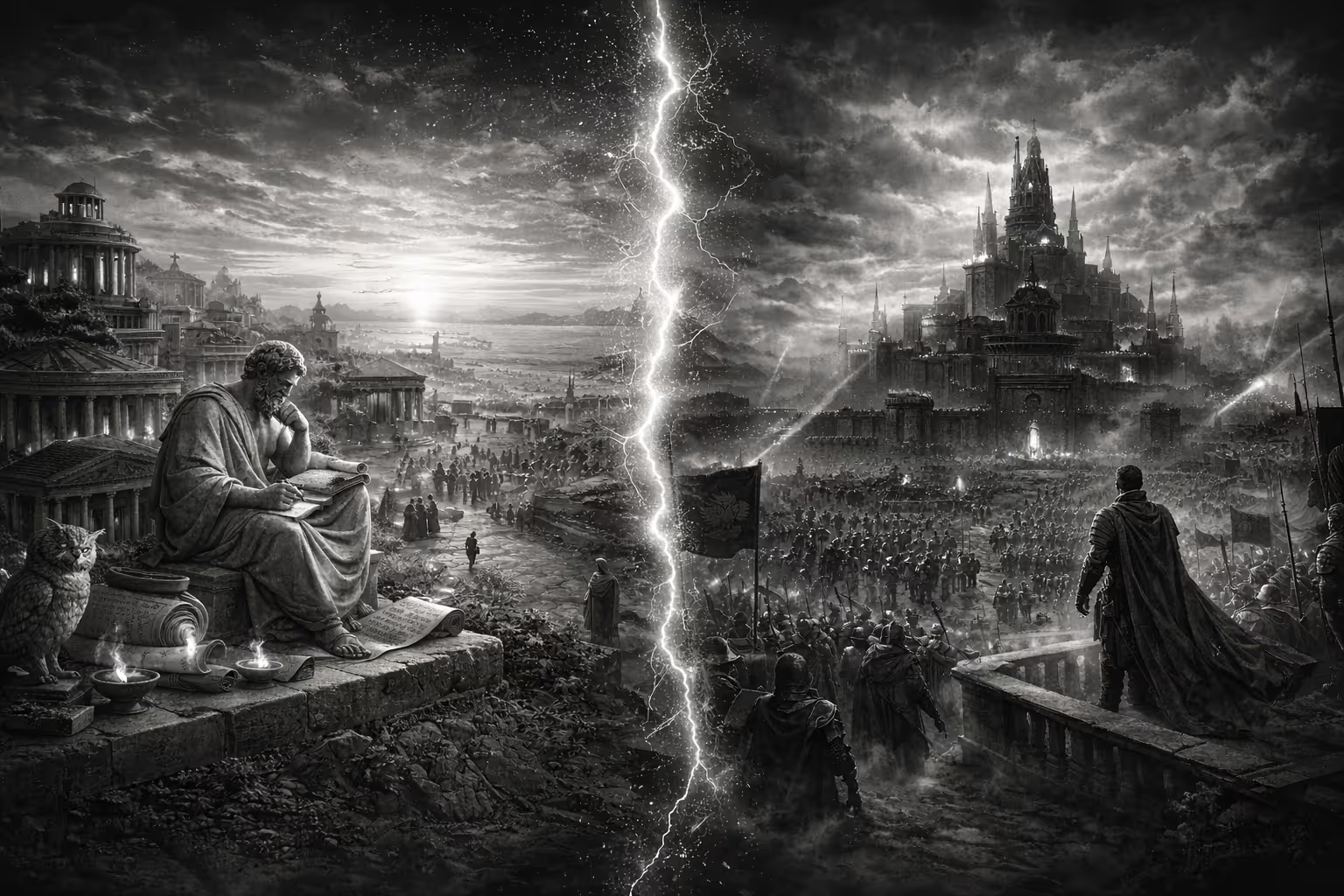
An empire of meaning versus an empire of control
The resilience of systems after the loss of their primary carrier is one of the most reliable indicators of their true quality. History suggests that the longest-lasting empires are not those built on rigid control, but those that create meanings capable of surviving both systemic collapse and absorption by more powerful structures — without losing their core identity.
In this sense, the figure of Alexander the Great is particularly revealing.
His military genius is well documented. Yet strategically more important was another dimension of his legacy: the diffusion of the Hellenistic cultural matrix — language, education, and written tradition — across the Eastern Mediterranean and the Near East. His early education, shaped under the intellectual influence of Aristotle, provided a rational framework of thought, though it did not directly dictate his later decisions. It functioned as an intellectual foundation rather than a behavioral script.
At the same time, the influence of his mother, Olympias — with her deeply symbolic and religious worldview — fostered a heightened sensitivity to the irrational, the mythological, and the sign-based dimensions of reality. The combination produced a rare configuration: rational education, behavioral flexibility, and a readiness to operate through asymmetries.
In an extraordinarily short period, Alexander created an empire with a weakly institutionalized internal architecture, not designed for long-term administrative continuity. Its stability did not rest on unification or rigid governance, but on integrative asymmetry.
Languages, beliefs, local knowledge, and elites of conquered territories were not eradicated; they were incorporated as assets, amplifying the system’s capacity for further expansion.
After Alexander’s death, the empire rapidly fragmented — a clear indication of the absence of a durable institutional framework. Yet his legacy proved far more resilient than the political structure itself: the emergence of a Hellenistic ontology across the region, the establishment of Greek as a language of knowledge and administration, and the rise of centers of cultural concentration — most notably the Alexandrian tradition of knowledge, which developed under the Ptolemies but was a direct consequence of the Hellenistic project he initiated.
This was not a legacy in the form of a state.
It was influence.
A similar pattern appears later in history. The wars of Napoleon Bonaparte, despite immense human loss and economic devastation, reshaped Europe by disseminating new conceptions of law, statehood, and national self-identification — effects that persisted long after his defeat.
In a contemporary business context, an analogous logic can be observed in LVMH — not as a structural comparison, but as a model of influence. It is not a technological platform and not a classical corporation, but a system operating through cultural codes: taste, status, desire, and emotion. This is precisely why it can function across radically different cultural environments, including relatively closed ones, without encountering the constraints typically imposed on technological monopolies.
The key conclusion follows naturally: resilience emerges at the intersection of technological and cultural codes.
Technologies are historically contingent and mutable.
Human behavioral patterns are, to a significant degree, universal.
Social symbols may dominate quickly.
But over the long term, it is cultural meaning that prevails.
It outlives empires.
And it is more durable than control.