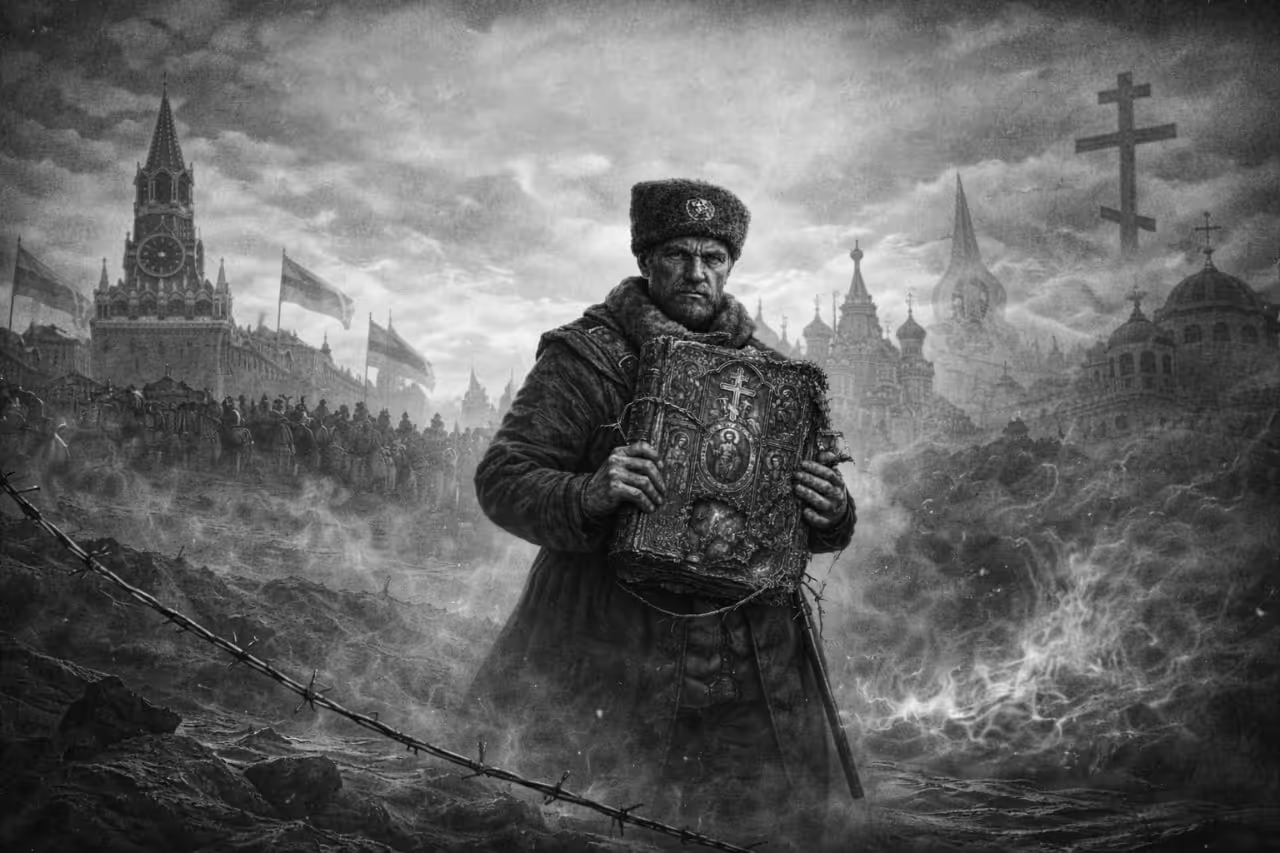
The Russian World as a Stolen Gospel
Poltava as Crucifixion, the False Apostolate, and the Rubicon of 2022
There are moments when violence is not the cause of history, but its confession.
Poltava was such a moment.
What occurred in 1708–1709 was not merely the defeat of a political project. It was a crucifixion of sovereign incarnation — a focused act that separated spirit from the right to become a system.
Crucifixion is not suffering.
Crucifixion is a structural operation.
Suffering without integration is meaningless. Pain acquires meaning only when it is integrated into force, and force into a system capable of reproduction. Otherwise, crucifixion remains torture — repetitive, sterile, unresolved.
Poltava was crucifixion without resurrection.
Spirit Preserved, Incarnation Suspended
After Poltava, Ukraine did not lose its spirit.
It lost its right to incarnate that spirit into its own sovereign form.
The Ukrainian logos survived.
The Ukrainian Vorstellung survived.
What was suspended was embodiment.
What followed was not destruction, but appropriation.
The emerging empire did not generate its own formative image. It extracted a foreign one, isolated it from sovereignty, and redeployed it within an alien will. Thus arose what would later be mythologized as the “Russian world”: a system in which Ukraine carried spirit, while another center administered incarnation.
The First Synod: Apostolic Form Without Revelation
The First Synod established by Peter was not a technical reform.
It was a deliberate imitation of apostolic architecture.
There were eleven members of the Synod.
Peter stood above them as the twelfth.
This was not symbolism.
It was structure.
After crucifixion, there are eleven apostles.
The twelfth position is the one that integrates the mission into the world.
But here the structure was hollowed out.
The Synod preserved apostolic form, while excluding resurrection.
This hollow form required content.
And that content did not come from the throne.
It was Ukrainian theologians — architects of meaning — who supplied the logos.
Figures formed in the Kyiv intellectual tradition — such as Feofan Prokopovych, Stefan Yavorsky, and others — carried into the Synod a coherent theological language, a grammar of legitimacy, and a vision of order capable of sustaining a system.
They provided doctrine, moral structure, educational continuity, and the intellectual scaffolding of authority.
The logos was Ukrainian; the integration was imperial. From this division, the system was born.
Peter did not generate this Vorstellung.
He appropriated it.
He seated himself as the twelfth at the table —
not as bearer of revelation,
but as administrator of чужого сенсу.
He did not claim to be Christ.
He claimed the position that integrates meaning into power.
Without calling.
Without revelation.
Without sacrifice.
This was not apostleship.
It was usurpation.
Apostolic Form as Hollow Expansion
The result was a system capable of expansion, discipline, and repetition — but incapable of renewal.
Meaning existed.
Origin did not.
This is apostolic service without resurrection: form without source, authority without revelation, structure without inner ground.
Such a system cannot regenerate itself. It can only reproduce — by force, ritual, and suppression of memory.
Why the Source Must Be Destroyed
A system built on appropriated Vorstellung cannot coexist with its source.
Ukraine is not dangerous because it resists.
Ukraine is dangerous because it remembers.
As long as the source exists:
- the theft is visible,
- integration is exposed as usurpation,
- the twelfth is revealed as self-appointed.
This is why destruction becomes doctrinal.
Cities are not destroyed because they fight.
They are destroyed because they carry the original image.
Fire here is not excess.
It is necessity — for a system whose origin cannot be acknowledged.
2022: Rubicon
2022 is the Rubicon.
Not escalation.
Not phase.
Not episode.
A point of irreversibility.
After the Rubicon, there is no return to:
- spirit without sovereignty,
- meaning without incarnation,
- sacrifice without system.
Either pain becomes force,
force becomes system,
and system becomes reproduction —
or crucifixion repeats, again without resurrection.
Final
What we see is not strength, but agony — the paralysis of a system that has iconized death and war as its only remaining form of life. All other forms were produced elsewhere. All other meanings were authored by Ukrainian architects of sense.
This system does not destroy because it is powerful.
It destroys because it has nothing left to create.
Resurrection is not victory.
Resurrection is irreversibility.
The right to incarnate one’s own formative image into a system — and never return.