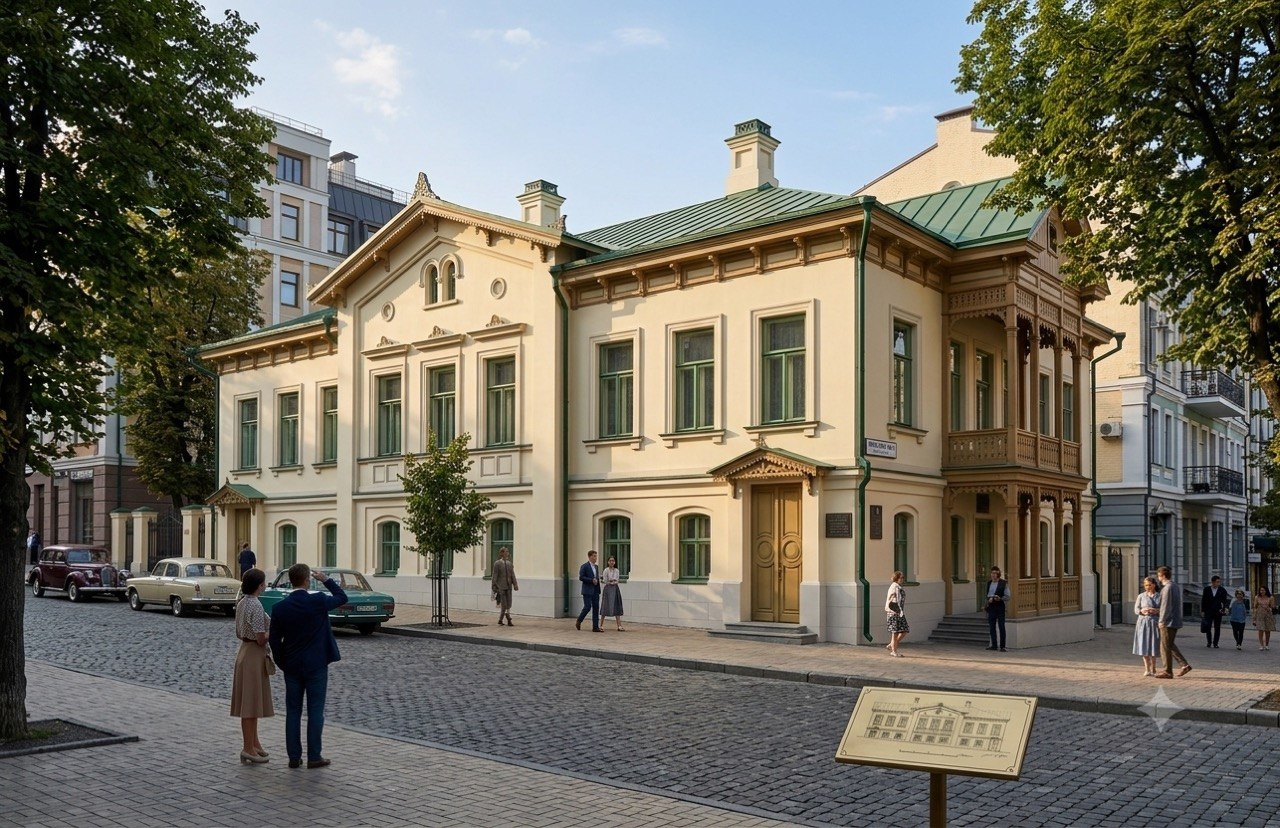
Historic Façade Building in Central Kyiv
Region: Kyiv, Yaroslaviv Val 27-B
Status: Court decision implementation and transition to operational
Yaroslaviv Val 27-B is a long-term project aimed at restoring the legal and operational status of a historic building located in the central district of Kyiv.
The initiative is being implemented by our team using our own resources as part of a broader effort to recover and responsibly develop historic urban assets.
Legal Basis, Status, and Current Stage of Implementation
The building located at 27-B Yaroslaviv Val, Kyiv forms part of the historic fabric of Yaroslaviv Val and belongs to an urban context that requires not declarative intentions, but a legally complete and responsibly structured approach.
Legal Basis
The rights to the building were established in favor of Intereffect Inc., a company incorporated in the State of Delaware, USA, pursuant to the court decision dated 05 December 2005 in case No. 2-1444/2005.
That decision did not create rights from scratch. Rather, it relied on an underlying title structure originating in 1996 and formalized the transfer of rights to the property in favor of Intereffect Inc. following the failure of private individuals to fulfill their financial obligations.
It is also important to note that the legal position of Intereffect Inc. extends beyond the real estate asset itself. The company also holds rights related to the control of the legal entity that was the original owner of the building. Accordingly, the legal position of Intereffect Inc. rests both on court-confirmed rights to the property and on its connection to the original ownership structure.
The Unimplemented Court DecisionIn 2006, the process of implementing the court decision was formally initiated. However, that process was never completed. In practical terms, the rights established by the court in favor of Intereffect Inc. remained unimplemented within the enforcement and registration systems.
It was precisely this gap between rights already established by the court and their failure to be fully implemented that became the source of long-standing legal uncertainty surrounding the building.
Consequences of the Long-Term Failure to Implement Established
Rights
Our position remains unchanged: law comes first. The present condition of the building and the legal environment surrounding it are the result not of an absence of rights, but of the prolonged failure to implement rights that had already been established.
That prolonged non-implementation created the conditions for subsequent registration actions, related legal distortions, corresponding criminal proceedings, and the gradual physical deterioration of the building itself, which today is in a de facto emergency condition.
Reaffirmation of Rights in 2026
In 2026, the rights of Intereffect Inc. to the building were reaffirmed through appellate and cassation review.
This includes, in particular, the ruling of the Supreme Court dated 16 February 2026 in case No. 2-1444/2005, proceeding No. 61-1831ск26.
Accordingly, the issue today is not the creation of a new legal position, nor an attempt to construct a new title. The issue is the completion of the implementation of an already existing court decision and the alignment of the legal status of the property with the rights already established by the court.
Current Ownership Context and the Role of the Present Team
It is important to emphasize that the long-term non-implementation of the court decision did not arise from the actions of the present team. Control over Intereffect Inc. was acquired in 2025 specifically for the purpose of completing a legal implementation process that had remained unfinished for years.
In other words, the present team did not create this legal problem. Its role is the opposite: to complete the already existing legal basis, restore the proper status of the property, and move the situation from a prolonged state of uncertainty into one of legal clarity.
Position Regarding the Current Use of the Building
As of today, the building is being used in fact by third parties. We do not approach this issue in terms of public or emotional conflict. The essential point, in our view, is to distinguish clearly between factual use of the property and the proper legal basis for such use. We proceed from a basic sequence: law — lease — operational use.
Only this sequence can provide a stable foundation for the future functioning of a historic property and serve the interests of all parties, including those currently present in or operating within the space.
Position Regarding the Restoration of the Building
Following the completion of the legal implementation of the court decision, a transition to the restoration phase of the heritage building may become possible. This building forms part of the original development of Yaroslaviv Val and retains historical significance within this part of Kyiv.
Intereffect Inc. has already provided comments on this matter to The Village Ukraine. We would like to reiterate a basic principle: only once the legal status of the property has been brought into full conformity can there be stable use, responsible restoration, investment, and the development of a viable long-term model for the building’s future.
This is precisely why the present team acquired control over Intereffect Inc. — not to enter into yet another conflict surrounding the asset, but to complete the legal implementation process, restore the proper status of the building, and move it into a coherent institutional framework.
We do not view this building as an object of speculative or situational interest. We view it as a historic urban asset that must be returned to a clear legal framework and prepared for responsible restoration and institutional investment.
Current Stage
At present, the current stage consists in securing the necessary procedural instruments for the full implementation of the already existing court decision and for returning the asset to a
clear legal and operational framework.
This is not a matter of reinterpreting the law, but of implementing it in full. Not of constructing a new framework, but of completing the one already established by the court.
Not of conflict around the building, but of restoring legal order as the only stable basis for its future.